
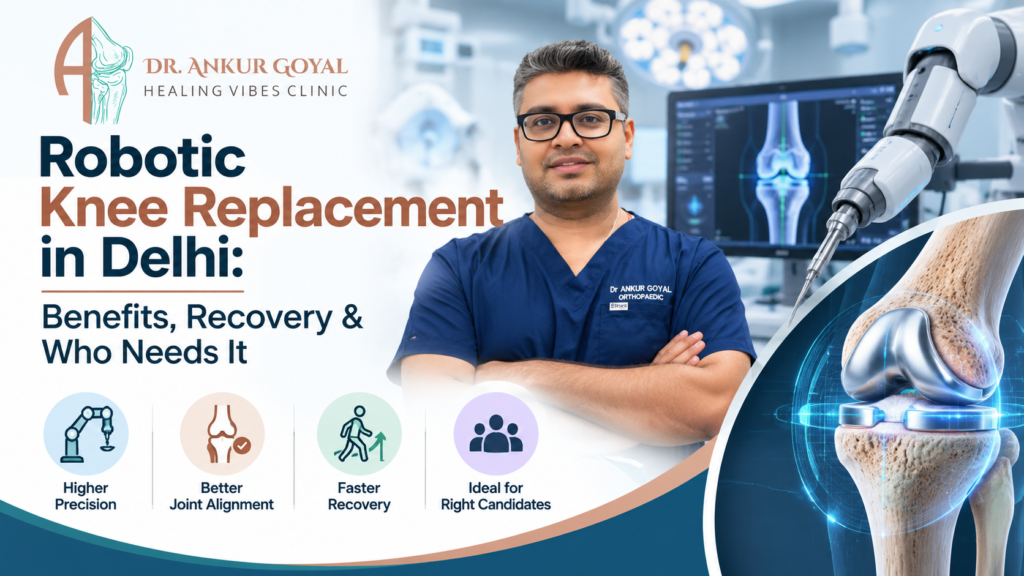
When stairs, short walks, even a night’s sleep start to hurt, someone usually mentions knee replacement. And right behind it comes a second word: robotic. Is it a real upgrade or just a better-sounding brochure? This guide explains what robotic knee replacement in Delhi actually involves, what it can and cannot promise, and how to decide.
Quick answer: Robotic knee replacement is a total or partial knee replacement where a robotic arm helps the surgeon plan and execute bone cuts with high precision. The surgeon still leads every step. It can improve implant alignment, but long-term results depend mostly on the right diagnosis, good surgical technique and disciplined rehabilitation.
What is robotic knee replacement?
In a knee replacement, the worn-out surface of the joint is removed and replaced with a metal and medical-grade plastic implant. In the robotic version, the surgeon uses a planning system (based on a CT scan or on mapping done in theatre) and a robotic arm that keeps the saw within a pre-set boundary. Think of it as a very steady guide, not an autopilot.
The robot does not decide anything and it does not operate on its own. Every decision, from implant size to alignment, still belongs to the orthopaedic surgeon.
Robotic vs conventional knee replacement
Both methods use the same kind of implants and aim at the same result: a pain-free, stable and straight knee. The difference is in how the cuts are planned and checked.
- Conventional: The surgeon uses cutting guides and experience to position the implant, and checks balance by feel and measurement.
- Robotic-assisted: A digital plan of your knee is made first. During surgery the robotic arm limits the cut to that plan, and the system shows how the soft tissues are balancing in real time.
Dr. Ankur Goyal’s clinic offers both robotic and conventional approaches, so the choice is made around your knee, not around the equipment.
Possible benefits, and what the evidence really says
Studies generally show that robotic assistance improves the accuracy of implant positioning. Some patients report less pain and a quicker return to walking in the first weeks. What is not yet firmly proven is that this accuracy always translates into a longer-lasting knee for everyone. Be wary of any promise of “100% perfect” results.
- More precise bone cuts and implant alignment
- Better control of ligament balance, which can help the knee feel natural
- Smaller margin for human error on cuts
- Possible gentler handling of surrounding soft tissue
Who actually needs a knee replacement?
Surgery is usually considered when pain from advanced arthritis stops you from doing everyday things and tablets, physiotherapy, weight management and injections no longer help. Typical signs include:
- Pain while walking, climbing stairs or getting up from a chair
- Night pain or pain even at rest
- Visible bowing of the legs or a stiff, swollen knee
- X-rays showing severe loss of cartilage
If your arthritis is earlier or the damage is limited, you may not need replacement yet. Read about joint preservation and cartilage repair to see which options can delay surgery.
What happens during the process
- Consultation and tests: examination, standing X-rays and, if needed, a CT scan for robotic planning.
- Fitness check: blood tests, heart and sugar control, and a review of your medicines.
- Surgery: done under spinal or general anaesthesia. The plan is confirmed, the cuts are made with robotic assistance and the implant is fitted.
- Same-day mobilisation: most patients are helped to stand and take a few steps with support within a day.
- Physiotherapy: starts early and continues for weeks. This part decides how good your knee will feel.
The implant choice also matters. Our article on cementless and porous implants explains how bone type and age influence that decision.
Recovery timeline (general guide)
- Hospital stay: usually a few days, depending on your health.
- First 2 weeks: walking with a walker, swelling control, bending exercises.
- 4 to 6 weeks: most people manage daily tasks and may return to desk work. Driving depends on your doctor’s clearance.
- 3 to 6 months: strength and confidence keep improving. Full recovery can take longer.
Every patient is different. Age, other health conditions and how faithfully you do your exercises all change this timeline.
What does robotic knee replacement cost in Delhi?
There is no single price. The final cost depends on the hospital and room type, the implant brand and material, whether one or both knees are done, the technology used and your insurance cover. Ask for a written estimate that lists what is and is not included. Our team at the clinic can explain this at your appointment.
Questions to ask before you decide
- Do I really need surgery now, or can I try other treatment first?
- Is a total or partial replacement better for my knee?
- Which implant do you recommend for me, and why?
- What will my first two weeks at home look like?
- What happens if something does not go as planned?
Consult Dr. Ankur Goyal in Malviya Nagar
Dr. Ankur Goyal (M.B.B.S., M.S., FISM) is an orthopaedic surgeon with a fellowship in sports medicine and a focus on knee, hip and trauma care. He sees patients at Healing Vibes Clinic, Geetanjali Enclave, Malviya Nagar, New Delhi. Learn more on the knee replacement page, or read why patients look for a knee replacement specialist in Malviya Nagar and what to expect from knee replacement surgery in Malviya Nagar. You can also read about Dr. Goyal.
Frequently asked questions
Is robotic knee replacement better than traditional surgery?
It can place the implant more accurately, which many surgeons value. But long-term benefit over conventional surgery is still being studied, so the best choice depends on your knee and your surgeon’s experience.
Is robotic knee replacement painful?
You will have pain after any knee replacement. Modern anaesthesia, pain-control protocols and early walking keep it manageable for most people.
How long does a replaced knee last?
Modern implants often last 15 to 20 years or more, depending on your weight, activity level, bone quality and how well the knee is cared for.
How soon can I walk after surgery?
Most patients are assisted to stand and walk within a day, using a walker at first.
Who should avoid knee replacement?
People with active infection, certain uncontrolled medical conditions or only mild arthritis may need other treatment first. Your surgeon will assess this after examination.
Can both knees be replaced together?
Sometimes, in selected fit patients. It is a decision made after checking your heart, lungs and overall strength.
How do I book a consultation?
Use the appointment page or call +91 8750355566 or +91 9871232677.
Knee pain getting in the way of daily life? Book an appointment with Dr. Ankur Goyal in Malviya Nagar, New Delhi. Or explore our orthopaedic services.
Disclaimer: This article is for general information and does not replace a medical examination. Treatment decisions should be made after consulting a qualified doctor.