
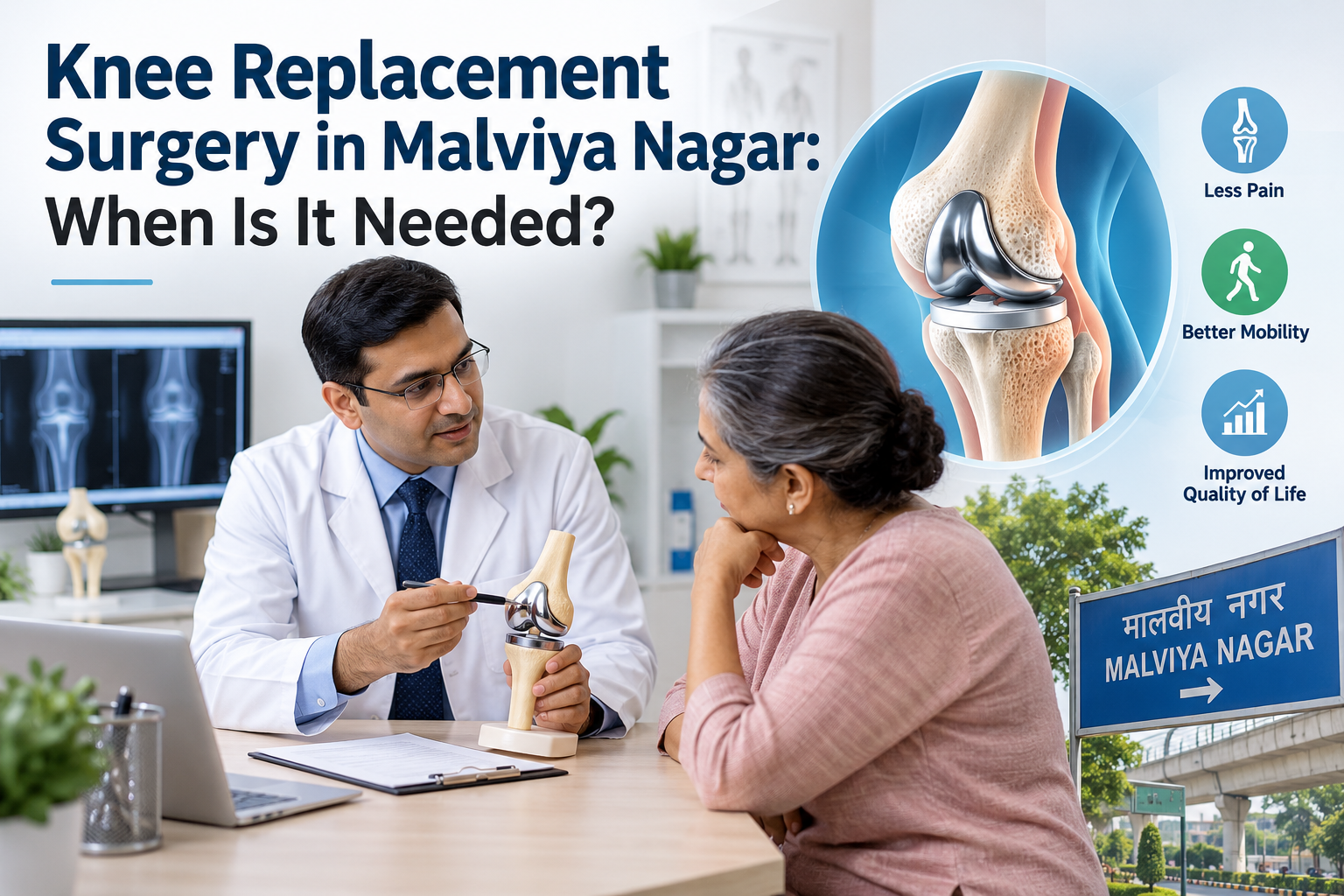
Knee Replacement Surgery in Malviya Nagar: When Is It Needed?
Knee pain can gradually affect many parts of daily life. Activities that once felt simple, such as walking, climbing stairs, getting up from a chair or taking a morning walk, may become increasingly uncomfortable. For some people, the problem is caused by arthritis or damage to the knee joint that does not improve sufficiently with non-surgical treatment.
Knee replacement surgery may be considered when persistent pain and stiffness significantly affect mobility and quality of life. However, not everyone with knee pain needs surgery. Understanding the cause of the problem, the available treatments and the expected recovery can help patients make an informed decision with their orthopaedic surgeon.
If you are looking for a Knee Replacement Specialist in Malviya Nagar, understanding the procedure and discussing your symptoms with a qualified orthopaedic surgeon can be a useful first step.
What Is Knee Replacement Surgery?
Knee replacement, also called knee arthroplasty, is a surgical procedure in which damaged parts of the knee joint are replaced with artificial components. These components are designed to help the joint move more comfortably and reduce pain caused by severe joint damage.
The knee joint contains cartilage that allows the bones to move smoothly against each other. Conditions such as osteoarthritis can gradually wear down this cartilage, causing pain, stiffness, swelling and reduced movement.
When these symptoms become severe and other treatment options no longer provide sufficient relief, a doctor may recommend evaluating the patient for knee replacement surgery.
To understand the procedure and available treatment approaches, read more about Advanced Knee Replacement and Minimally Invasive Surgery in Delhi.
Common Signs That You May Need a Knee Replacement Evaluation
Persistent knee pain does not automatically mean that surgery is necessary. However, certain symptoms indicate that an orthopaedic assessment may be helpful.
1. Persistent Knee Pain
Pain that continues for weeks or months, especially when walking, standing or performing everyday activities, should be evaluated. Pain that occurs even while resting or interferes with sleep may indicate a more advanced joint problem.
2. Difficulty Walking or Climbing Stairs
When knee stiffness or pain makes it difficult to walk short distances, climb stairs or get up from a chair, everyday independence can be affected.
3. Stiffness and Reduced Knee Movement
Some patients experience difficulty bending or straightening their knee. Significant stiffness can interfere with routine activities and may require further investigation.
4. Swelling or Changes in Knee Alignment
Repeated swelling, changes in the shape of the knee or increasing difficulty putting weight on the affected leg should be discussed with a medical professional.
5. Limited Relief From Non-Surgical Treatments
Physiotherapy, appropriate medication, activity modification and other recommended treatments may help manage knee symptoms. If these approaches no longer provide sufficient relief, an orthopaedic surgeon can assess whether other options, including surgery, should be considered.
What Conditions Can Lead to Knee Replacement Surgery?
Several conditions can damage the knee joint. The most common is osteoarthritis, a degenerative condition in which the protective cartilage gradually wears away.
Other conditions that may lead to consideration of knee replacement include:
- Rheumatoid arthritis: An inflammatory condition that can damage the joint.
- Post-traumatic arthritis: Joint damage that develops after a significant knee injury.
- Advanced cartilage damage: Severe wear that affects normal joint movement.
- Severe joint degeneration: Damage that causes persistent pain and limits daily activities.
The appropriate treatment depends on the diagnosis, the extent of joint damage, the patient’s overall health and how symptoms affect daily life.
Types of Knee Replacement Surgery
There is no single knee replacement procedure that is suitable for every patient. The choice depends on which parts of the knee are damaged and the surgeon’s clinical assessment.
1. Total Knee Replacement
In total knee replacement, the damaged joint surfaces are replaced with artificial components. It may be considered when arthritis or other damage affects multiple parts of the knee.
2. Partial Knee Replacement
Partial knee replacement involves replacing only the damaged portion of the knee. It may be suitable for selected patients whose damage is limited to one compartment and whose remaining joint structures meet the necessary criteria.
3. Robotic-Assisted or Computer-Guided Knee Replacement
These techniques use technology to assist surgical planning and component positioning. Whether they offer a meaningful advantage for an individual patient depends on the clinical situation, the equipment available and the surgeon’s assessment.
4. Revision Knee Replacement
Revision surgery may be required when a previous knee replacement develops a problem, such as implant loosening, infection or significant wear. It is a more complex procedure and requires individual evaluation.
Is Minimally Invasive Knee Replacement Suitable for Everyone?
Patients researching Knee Replacement Surgery in Malviya Nagar may come across the term minimally invasive knee replacement.
Depending on the surgical technique, minimally invasive approaches aim to reduce disruption to the tissues around the knee. However, the term does not mean that the operation is risk-free or that every patient will recover at the same speed.
Suitability depends on factors such as the extent of arthritis, knee alignment, anatomy, general health and the surgeon’s clinical judgement.
The most appropriate approach is the one that addresses the patient’s joint condition safely and effectively. A consultation can help explain which surgical options may be suitable and what their potential benefits and limitations are.
For additional information, visit the knee replacement and minimally invasive surgery page.
What Are the Benefits and Risks of Knee Replacement?
For appropriately selected patients, knee replacement can help reduce arthritis-related pain, improve joint function and make daily movement easier.
Potential benefits include:
- Reduced pain caused by severe joint damage.
- Improved ability to walk and perform everyday activities.
- Better knee function following rehabilitation.
- Improved quality of life when pain has significantly restricted mobility.
As with any major operation, knee replacement also carries risks. These may include infection, blood clots, bleeding, stiffness, persistent pain, implant-related problems and complications related to anaesthesia.
The likelihood of complications varies according to a person’s health, the procedure and other individual factors. Patients should discuss the expected benefits, risks and alternatives with their surgeon before deciding on surgery.
What Is the Recovery Process After Knee Replacement?
Recovery is gradual and differs from person to person. It depends on the type of surgery, general health, pre-existing mobility and participation in rehabilitation.
Early Recovery
The healthcare team will guide pain management, wound care and safe movement after surgery. Many patients begin standing or walking with assistance soon after the procedure, when medically appropriate.
Physiotherapy and Exercise
Rehabilitation is an important part of recovery. A physiotherapist may recommend exercises to improve knee movement, strengthen surrounding muscles and gradually restore walking ability.
Patients should follow their prescribed exercise plan rather than starting strenuous activities independently.
Returning to Daily Activities
Some patients resume basic activities within several weeks, but full recovery can take several months or longer. Driving, returning to work, and resuming more demanding activities should depend on the patient’s progress and medical advice.
Following instructions on wound care, medication, mobility, and follow-up appointments can help support recovery.
How to Choose a Knee Replacement Specialist in Malviya Nagar
Choosing a surgeon involves more than searching for the nearest clinic. Patients should consider relevant qualifications, experience with joint replacement procedures, communication, and the availability of appropriate follow-up care.
Before making a decision, consider asking:
- What is causing my knee pain, and how advanced is the damage?
- Are non-surgical treatments still appropriate for me?
- Would partial or total knee replacement be more suitable?
- What are the benefits and risks of the recommended procedure?
- What rehabilitation and follow-up will I need?
- What results are realistic for my particular condition?
If you are comparing options for the Best Knee Replacement Specialist in Malviya Nagar, focus on your individual diagnosis, the surgeon’s relevant expertise and a clear discussion of treatment choices rather than relying on rankings or promotional claims alone.
Consult Dr. Ankur Goyal for Knee Replacement Evaluation in Malviya Nagar, Delhi
Dr. Ankur Goyal provides orthopaedic care, including evaluation and treatment options for knee joint problems and joint replacement.
Patients experiencing persistent knee pain, stiffness or difficulty walking can arrange a consultation to understand the cause of their symptoms and discuss appropriate treatment options.
If you want to learn more about available procedures, read the dedicated guide to Advanced Knee Replacement and Minimally Invasive Surgery in Delhi.
A consultation can help determine whether conservative treatment, further investigation or knee replacement surgery may be appropriate for your condition.
Frequently Asked Questions About Knee Replacement
1. When should someone consider knee replacement surgery?
Knee replacement may be considered when severe joint damage causes persistent pain, stiffness and difficulty with everyday activities, particularly when appropriate non-surgical treatments have not provided sufficient relief. A surgeon must assess the individual before recommending surgery.
2. Who is a suitable candidate for knee replacement?
Suitability depends on the extent of joint damage, pain, mobility, overall health and the response to other treatments. Age alone does not determine whether someone is suitable.
3. Is knee replacement surgery always necessary for knee arthritis?
No. Many patients can manage symptoms with exercise, physiotherapy, appropriate medication and lifestyle changes. Surgery is generally considered when symptoms remain significantly limiting despite suitable non-surgical treatment.
4. How long does recovery take after knee replacement?
Recovery varies. Some patients resume basic activities within several weeks, while further improvement in strength, movement and comfort may take several months or longer. The treating team can provide guidance based on individual progress.
5. Is minimally invasive knee replacement better for every patient?
No. The suitability of a minimally invasive approach depends on the patient’s anatomy, joint damage and other clinical factors. The surgeon should explain the available approaches and their potential advantages and limitations.
6. Where can I consult a knee replacement specialist in Malviya Nagar?
You can visit Dr. Ankur Goyal’s official website to find information about his orthopaedic services and contact details. Confirm the current clinic location and consultation availability before visiting.
7. How can I learn more about knee replacement surgery in Delhi?
You can read the dedicated knee replacement service page for further information about the procedure and available treatment approaches.
Final Thoughts
Persistent knee pain should not be ignored, particularly when it begins to affect walking, sleep or everyday independence. Although knee replacement can be helpful for selected patients with advanced joint damage, the right treatment depends on a careful clinical assessment.
Understanding your diagnosis, discussing available alternatives and preparing for rehabilitation can help you make a more informed decision about your knee health.
If knee pain is affecting your daily routine, consider arranging an orthopaedic consultation to discuss the next appropriate steps.
Medical Disclaimer: This article is for general educational purposes and is not a substitute for an individual medical consultation. Treatment recommendations and surgical outcomes vary between patients.