
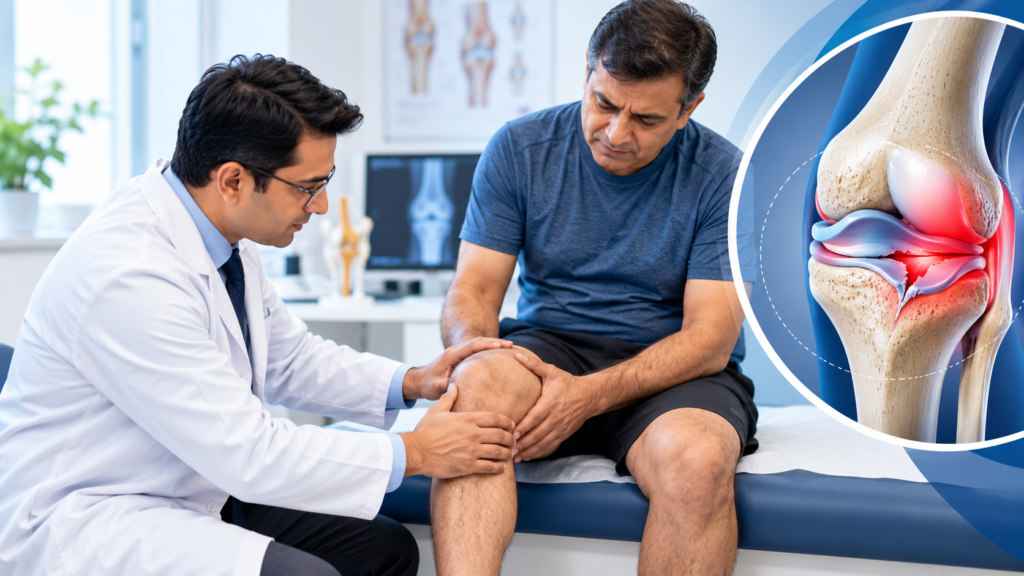
Why Does Your Knee Lock or Catch? Causes and When to See a Doctor
Does your knee suddenly feel stuck when you bend it, or does it catch when you try to straighten your leg? Knee locking and catching can make walking, climbing stairs and everyday activities uncomfortable.
These symptoms can occur for several reasons, including meniscus injuries, cartilage problems and other joint conditions. However, not every clicking knee indicates a serious injury.
In this guide, learn what knee locking means, what may cause it, which warning signs need attention and when to consult an orthopaedic doctor.
What Does Knee Locking or Catching Mean?
Knee locking describes a sensation that the knee becomes stuck during movement. In some cases, a person cannot fully bend or straighten the knee.
Knee catching is slightly different. It describes a brief sensation that something is interfering with smooth joint movement.
You may also notice clicking, popping, stiffness or pain while walking, squatting or getting up from a chair.
Occasional painless clicking can be harmless. However, persistent catching, painful clicking or a knee that becomes physically stuck should be assessed by a healthcare professional.
What Causes Knee Locking and Catching?
Several conditions can cause these symptoms. The exact cause depends on your medical history, the type of movement involved and whether pain or swelling is present.
1. Meniscus Injury
The meniscus is a piece of specialised cartilage inside the knee that helps distribute weight and absorb forces between the thighbone and shinbone.
A meniscus tear can occur when the knee twists suddenly, particularly while the foot remains planted during sports. Tears can also develop gradually with age-related changes.
Common symptoms may include:
- Pain along the inner or outer side of the knee
- Swelling after an injury
- Difficulty bending or straightening the leg
- Catching or locking during movement
- A feeling that the knee may give way
Not every meniscus tear causes symptoms or requires surgery. A medical assessment helps determine whether the tear is responsible for your symptoms and which treatment may be appropriate.
Learn more about arthroscopy and joint injury treatment.
2. Loose Bodies Inside the Joint
Small fragments of bone or cartilage can sometimes move within the knee joint. These fragments are known as loose bodies.
Depending on their size and location, they may interfere with normal movement. As a result, the knee may catch or occasionally become stuck.
A doctor may recommend imaging tests if the examination suggests a loose body or another structural problem.
3. Cartilage Damage
Cartilage helps the joint surfaces move smoothly. Damage to cartilage can occur following an injury or alongside joint degeneration.
In some cases, cartilage damage contributes to pain, swelling or restricted movement. However, symptoms alone cannot identify the exact structure involved.
An orthopaedic examination can help determine whether further investigations are necessary.
4. Knee Arthritis
Arthritis can cause pain, stiffness and reduced movement. Some people also experience grinding or creaking sensations when bending the knee.
Although arthritis can contribute to difficulty moving the joint, a true mechanical lock may indicate a different or additional problem.
If your knee symptoms are persistent, consult a doctor to determine the underlying cause. You can also read about the orthopaedic services available for arthritis.
5. Ligament or Other Knee Injuries
Ligaments help stabilise the knee. Injuries involving the ACL or other supporting structures can cause pain, swelling and a feeling that the knee is giving way.
These injuries do not always cause true locking. However, multiple structures may be affected during the same incident, especially after a sudden twist or sports injury.
For this reason, an assessment is important after a significant knee injury. You can explore sports injury care and treatment options.
Is Knee Clicking Normal?
Occasional knee clicking without pain, swelling or restricted movement is often not a cause for concern.
However, painful clicking or catching deserves more attention, particularly when it begins after an injury.
Consider arranging a medical assessment if you notice:
- Repeated painful clicking
- Swelling around the knee
- Difficulty fully straightening the leg
- A feeling that the knee may give way
- Symptoms that interfere with walking or daily activities
These signs do not automatically mean that surgery is required. The right approach depends on the underlying cause and severity of the problem.
What Should You Do If Your Knee Gets Stuck?
If your knee suddenly catches or locks, avoid forcing it through the movement.
Follow these practical precautions while arranging appropriate medical advice:
- Stop the activity that triggered the symptoms.
- Avoid twisting, deep squatting or movements that increase the pain.
- Rest in a comfortable position without forcing the knee straight.
- If swelling develops after an injury, apply a cold pack wrapped in a towel for short periods.
- Seek medical assessment if locking persists, movement becomes restricted or symptoms recur.
Do not try to unlock the knee by force or perform aggressive stretching exercises.
Important: If your knee is physically stuck and you cannot straighten it, seek urgent medical assessment. If you cannot bear weight after a significant injury, or the knee becomes severely swollen, hot or red with fever, obtain prompt medical care.
How Is Knee Locking Diagnosed?
A doctor will usually begin by asking when the symptoms started, whether an injury occurred and which movements cause discomfort.
The assessment may include:
Medical History and Physical Examination
The doctor may examine your knee’s movement, swelling, tenderness and stability. Your symptoms and examination findings help guide the next steps.
X-Ray
An X-ray can help assess bones, joint alignment and certain signs of arthritis. However, it does not directly show a meniscus tear.
MRI Scan
An MRI may be recommended when the doctor suspects a meniscus tear, ligament injury or another soft-tissue problem. Not everyone with knee clicking needs an MRI.
The choice of investigation depends on the suspected cause, examination findings and whether the result would affect treatment.
Does a Locking Knee Always Need Surgery?
No. Treatment depends on the cause of the locking, the severity of symptoms and the findings on examination or imaging.
Some people improve with activity modification, suitable rehabilitation and other non-surgical treatment. Others may need a procedure if a structural problem causes persistent mechanical locking or if symptoms do not improve with appropriate care.
Surgery is not automatically necessary just because a scan shows a meniscus tear. The doctor should consider the symptoms, clinical findings and individual needs before recommending treatment.
If arthroscopy is being considered, discuss its potential benefits, risks, alternatives and expected recovery with your orthopaedic surgeon.
When Should You See an Orthopaedic Doctor?
Arrange an assessment if your knee repeatedly catches, painful clicking continues or you have difficulty bending or straightening your leg.
Seek urgent assessment if your knee becomes physically locked, you cannot bear weight after an injury or the swelling is severe. A hot, red knee accompanied by fever also requires urgent medical attention.
If symptoms started after a sports injury, avoid returning to the activity until it is safe to do so.
Knee Assessment with Dr. Ankur Goyal in Malviya Nagar, Delhi
Persistent knee locking or catching can affect daily activities and make movement difficult. An orthopaedic assessment can help identify possible causes and guide appropriate treatment.
Dr. Ankur Goyal specialises in knee and hip conditions, sports injuries, trauma and joint replacement. To enquire about a consultation, visit the official Dr. Ankur Goyal website and use the available appointment contact details.
The recommended treatment will depend on your symptoms, examination and medical needs.
Frequently Asked Questions
Why does my knee lock when I bend it?
Knee locking can occur because of a meniscus tear, a loose fragment inside the joint or another structural problem. An examination is needed to identify the cause.
Why does my knee click but not hurt?
Painless clicking can occur during normal joint movement and is often harmless. However, clicking accompanied by pain, swelling or restricted movement should be assessed.
Can a meniscus tear cause knee locking?
Yes. Some meniscus tears can cause catching or true mechanical locking. However, not every tear causes these symptoms, and other conditions can produce similar problems.
Can knee locking go away on its own?
Some mild symptoms improve with time and appropriate care. However, a knee that remains physically stuck or cannot fully straighten needs urgent assessment rather than waiting for it to resolve.
Do I need an MRI for knee locking?
Not always. The doctor may recommend an MRI if the history and physical examination suggest a meniscus tear, ligament injury or another soft-tissue problem.
Does knee locking always require surgery?
No. Some causes can be managed without surgery. A procedure may be considered when there is persistent mechanical locking or another problem for which surgery is appropriate.
When should I seek urgent medical help for knee locking?
Seek urgent assessment if your knee is physically stuck, you cannot bear weight after a significant injury or you develop severe swelling. A hot, red knee with fever requires urgent medical attention.
Medical Disclaimer
This article is for general educational purposes only and does not replace professional medical advice, diagnosis or treatment. Consult a qualified healthcare professional for an assessment of your individual symptoms.