
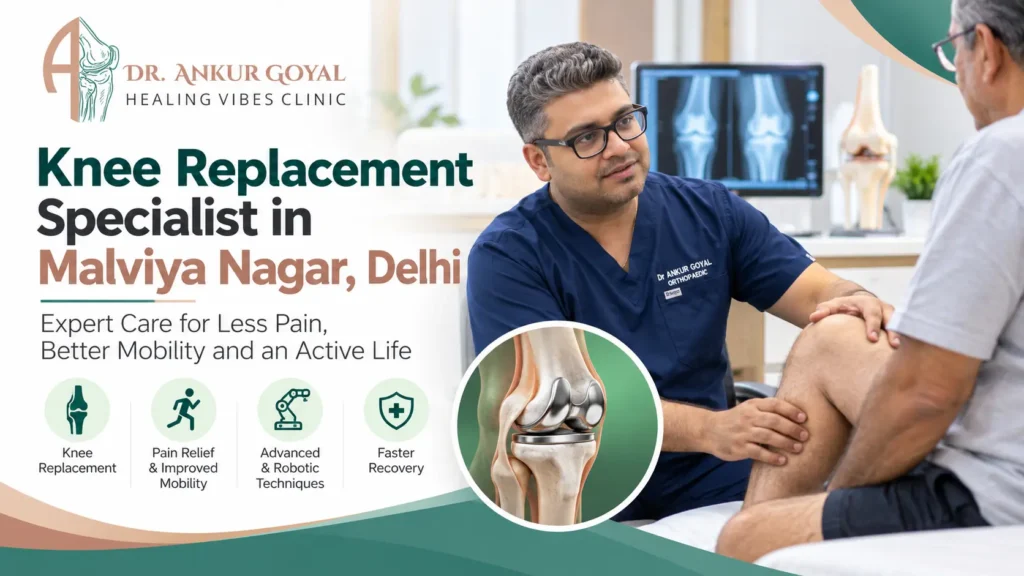
Knee Replacement Specialist in Malviya Nagar, Delhi
By Dr. Ankur Goyal, Orthopaedic Surgeon (M.B.B.S., M.S., FISM), Healing Vibes Clinic, Malviya Nagar. Clinical content reviewed for accuracy. Last updated: 24 October 2026.
Most people don’t walk into a knee replacement consultation by choice. They get there after years of “managing”: a knee cap on the left, a stairs-only-when-necessary rule at home, a cancelled trip to a relative’s wedding because of the steps at the venue. By the time they sit across from a specialist, the real question isn’t “what is knee replacement?” It is: can I trust this person with my knee, and do I really need this surgery?
This guide answers both, for anyone in Malviya Nagar, Saket, Hauz Khas, Panchsheel and nearby South Delhi neighbourhoods.
Quick answer: A knee replacement specialist is an orthopaedic surgeon who focuses on diagnosing severe knee arthritis and replacing the damaged joint surfaces with an artificial implant. You should consider one when knee pain limits daily life and tablets, physiotherapy, weight management and injections have stopped helping. A good specialist will first tell you whether you need surgery at all.
Knee replacement at a glance
| Who it is for | Adults with advanced knee arthritis or joint damage that no longer responds to non-surgical care |
| Surgery time | Roughly 1 to 2 hours per knee |
| Hospital stay | Usually a few days, depending on health and recovery |
| Walking | Assisted standing and steps usually start within a day |
| Back to desk work | Often 4 to 6 weeks |
| Full recovery | Several months; strength keeps improving for up to a year |
| Implant life | About 82% of knee replacements last 25 years, per a Lancet analysis |
Signs it may be time to see a knee specialist
- Pain while walking, climbing stairs or getting up from a chair, most days
- Pain at night or at rest that disturbs your sleep
- Stiffness, swelling or a knee that feels like it may give way
- Visible bowing of the legs (knock-knee or bow-leg deformity)
- X-rays showing the joint space has narrowed badly
- Six months or more of proper non-surgical treatment with little relief
One honest caution: pain alone does not mean you need a replacement. A locking or catching knee, for instance, may be a meniscus problem rather than arthritis. Our article on why a knee locks or catches explains the difference.
What a knee replacement specialist actually does
A good first visit is mostly conversation and examination, not a surgery date. Expect the specialist to:
- Ask how the pain affects your day: walking distance, stairs, sleep, prayer or floor sitting
- Examine your knee for alignment, stability, range of movement and swelling
- Review standing X-rays and, where needed, MRI or other tests
- Explain every reasonable option, including those that do not involve surgery
- Discuss your other health conditions, such as diabetes, blood pressure and heart health
If anyone fixes a surgery date in five minutes without examining you properly, take a second opinion.
Try non-surgical and joint-preserving options first
Many patients can delay replacement, sometimes for years, with weight management, physiotherapy, activity changes, supervised medication and, in selected cases, injections or cartilage-focused treatment. Read about joint preservation and cartilage repair and our arthritis treatment approach. Surgery makes sense when these options have run out of road, not before.
Types of knee replacement
- Total knee replacement: all damaged surfaces of the joint are resurfaced. This is the most common operation.
- Partial knee replacement: only one damaged compartment is replaced, in carefully selected patients.
- Robotic-assisted replacement: a robotic arm helps the surgeon plan and execute precise bone cuts. See our guide to robotic knee replacement in Delhi.
- Cemented or cementless implants: the choice depends on bone quality and age. Here is the evidence on cementless and porous implants.
For a full overview of procedures, visit our knee replacement page.
How to choose a knee replacement specialist in Malviya Nagar
Skip the “best surgeon” claims. Check these instead:
- Training: an orthopaedic degree (M.S. or DNB) and extra training in joint replacement or sports medicine
- Focus: a surgeon who regularly performs joint replacements, not occasionally
- Honesty: willingness to say “not yet” when surgery isn’t necessary
- Clarity: explains risks, implant choice and recovery in plain language
- Follow-up: a clear plan for physiotherapy, wound checks and long-term review
- Transparency: a written, itemised cost estimate
What surgery and recovery look like
- Pre-operative check: blood tests, heart and sugar control, medicine review.
- Surgery: under spinal or general anaesthesia, usually 1 to 2 hours per knee.
- Day 0 to 1: you are helped to stand and take your first steps with a walker.
- Weeks 1 to 2: swelling control, bending exercises and wound care.
- Weeks 4 to 6: most people manage daily tasks and may return to desk work.
- Months 3 to 6 and beyond: strength, balance and confidence improve steadily.
The exercises you do at home matter as much as the operation. People who skip physiotherapy often end up with a stiff knee, however good the surgery.
Risks you should hear about
Knee replacement is common and generally safe, but no operation is risk-free. Possible complications include infection, blood clots, stiffness, persistent pain, implant loosening over time and, rarely, nerve or blood-vessel injury. Careful screening, clot prevention and early movement lower these risks. Your surgeon should discuss them with you before you consent.
How long does a knee replacement last?
A large systematic review and meta-analysis published in The Lancet in 2019 found that about 82% of total knee replacements were still working 25 years later (study summary). Your own results depend on your weight, activity level, bone quality and how well you follow the rehabilitation plan.
What affects the cost?
There is no standard price, and be wary of anyone who quotes one without examining you. The final cost depends on the hospital and room category, implant type, one knee versus both, technology used, length of stay and insurance cover. Ask for a written estimate that lists what is included.
Meet Dr. Ankur Goyal
Dr. Ankur Goyal is an orthopaedic surgeon (M.B.B.S., M.S., FISM) with a fellowship in sports medicine and a practice built around knee, hip, trauma and sports injury care. He is director of Healing Vibes Clinic, LGF, C-14, near Aurobindo College, Geetanjali Enclave, Malviya Nagar, New Delhi 110017. Read his full profile, watch patient testimonials, or take a look at the clinic facilities. For a broader view, see our page on the orthopaedic doctor in Malviya Nagar and common orthopaedic concerns.
Frequently asked questions
Who is the best knee replacement specialist in Malviya Nagar?
The “best” surgeon is the one with proper orthopaedic training, regular joint replacement experience, honest advice and a clear follow-up plan. Meet the doctor, ask questions and compare, rather than relying on rankings.
When should I get a knee replacement?
When advanced arthritis keeps you from normal daily activities and non-surgical treatment has not helped for several months. Age alone is not the deciding factor.
Is knee replacement surgery painful?
There is pain after surgery, but modern anaesthesia, nerve blocks and structured pain control keep it manageable. Most patients say the long-term pain relief is worth it.
How long is the hospital stay?
Usually a few days, depending on your health and how quickly you start walking and bending the knee.
How long does a knee replacement last?
Research shows about 82% of knee replacements last 25 years. Weight, activity and good rehabilitation affect how long yours will last.
Can both knees be replaced at the same time?
Sometimes, in selected fit patients after a careful heart and lung assessment. Many surgeons prefer to stage the surgeries.
Can I avoid knee replacement?
In early or moderate arthritis, weight loss, physiotherapy, supervised medication and joint-preserving treatment can delay or avoid surgery. Severe damage usually needs replacement.
How do I book a consultation?
Use the appointment page or call +91 8750355566 or +91 9871232677.
Knee pain holding you back? Book a consultation with Dr. Ankur Goyal at Healing Vibes Clinic, Malviya Nagar. You will get an honest opinion, including whether you need surgery at all.