
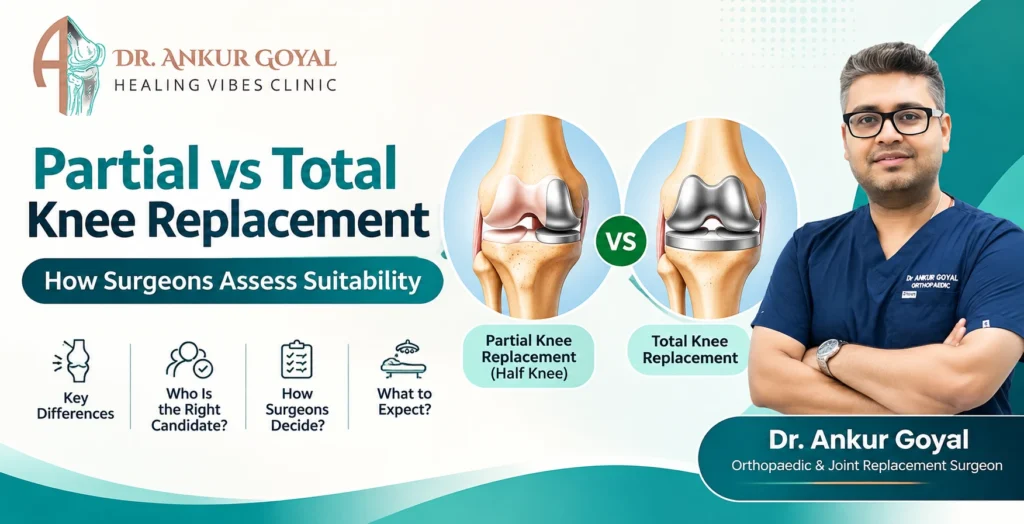
A total knee replacement treats damaged joint surfaces across the knee. Surgeons usually recommend this procedure when arthritis affects more than one compartment. It may also help patients who experience severe pain, stiffness or difficulty with daily activities.
The main goal is to reduce pain and help patients perform everyday activities more comfortably.
Who Is Suitable for Partial Knee Replacement?
Partial knee replacement suitability depends on the location of arthritis, ligament strength, knee movement and overall joint health. Therefore, surgeons do not decide suitability based on age or pain level alone.
A patient may qualify for partial knee replacement when:
- Arthritis mainly affects one compartment of the knee.
- The other compartments have healthy or well-preserved cartilage.
- Important supporting ligaments, especially the ACL, work properly.
- The knee has a reasonable range of movement.
- The patient does not have severe knee stiffness.
- Other treatments have not provided enough relief.
However, these factors do not confirm suitability on their own. The surgeon must examine the knee and review the patient’s scans. Also, pain on one side of the knee does not automatically make someone a suitable candidate.
When Do Surgeons Recommend Total Knee Replacement?
Surgeons may recommend total knee replacement when arthritis affects several compartments or causes extensive joint damage.
For example, they may suggest this procedure when a patient has:
- Advanced arthritis across the knee.
- Significant changes in knee alignment.
- Severe stiffness or limited knee movement.
- Damage to multiple joint surfaces.
- Persistent pain that affects daily activities despite non-surgical treatment.
Total knee replacement treats a wider area of joint damage. However, the surgeon does not recommend it simply because it is a more extensive procedure. Instead, the surgeon considers the patient’s symptoms, examination findings and imaging results before making a decision.
How Do Surgeons Assess Partial vs Total Knee Replacement?
Surgeons follow a detailed assessment before choosing between partial and total knee replacement. They check several factors to understand the condition of the joint and select a suitable treatment.
1. Location of Arthritis
First, the surgeon checks which compartment has arthritis. Weight-bearing X-rays help show the space between the bones and the pattern of joint damage.
If arthritis mainly affects one compartment, partial replacement may be an option. However, damage across several compartments may make total replacement more suitable.
2. Ligament Stability
The ACL and other supporting ligaments help keep the knee stable. Therefore, surgeons check their strength and function before recommending partial knee replacement.
This step is important because partial replacement preserves the remaining natural knee structures. The patient needs suitable ligament support for the procedure.
3. Knee Movement and Alignment
The surgeon checks how well the patient can bend and straighten the knee. In addition, the surgeon looks for stiffness, deformity and changes in leg alignment.
These findings help the surgeon understand how the knee works during everyday activities.
4. Imaging and Medical History
X-rays help surgeons assess joint damage and the space between the bones. In some cases, they may also recommend an MRI to examine cartilage, ligaments or other structures more closely.
The surgeon also reviews previous injuries, operations and treatments. As a result, these details help build a clearer picture of the patient’s knee health.
5. Daily Activities and Patient Expectations
Every patient has different needs and activity levels. For example, some patients want to walk comfortably, while others want to return to work or regular physical activities.
The surgeon discusses these goals during the consultation. Therefore, the final treatment plan considers both medical findings and the patient’s daily needs.
Partial vs Total Knee Replacement: Key Differences
Both procedures aim to reduce pain and improve knee function. However, they treat different levels of joint damage.
| Comparison | Partial Knee Replacement | Total Knee Replacement |
|---|---|---|
| Area replaced | One damaged compartment | Damaged joint surfaces across the knee |
| Healthy tissue | Preserves more healthy structures | Resurfaces more joint surfaces |
| Ligaments | Usually preserves the ACL | Implant design may replace or support some ligament functions |
| Recovery | Often quicker in suitable patients | May take longer |
| Best suited for | Arthritis limited to one compartment | More widespread arthritis |
Partial replacement may help suitable patients recover faster during the early stages. It also preserves more of the natural knee. However, arthritis may develop in the untreated compartments over time. Some patients may then need another operation.
On the other hand, total replacement treats wider joint damage. Therefore, surgeons may recommend it when arthritis affects several compartments.
Neither procedure suits every patient. Correct patient selection plays an important role in treatment planning.
Is Partial Knee Replacement Available in Delhi?
Patients exploring partial knee replacement in Delhi should consult an orthopaedic surgeon who can assess both partial and total replacement options. The surgeon should explain why one procedure may suit the patient’s condition better than the other. In addition, patients should understand the benefits, limitations and possible risks of each option.
At Healing Vibes Clinic in Geetanjali Enclave, Malviya Nagar, South Delhi, Dr. Ankur Goyal provides orthopaedic care for knee and joint conditions. He holds MBBS and MS qualifications and has completed an FISM Trauma and Joint Replacement Fellowship. His practice includes conventional and robotic-assisted knee replacement, along with arthroscopic and joint-preserving procedures.
If you are searching for a knee replacement surgeon in Malviya Nagar, you can discuss your symptoms, medical reports and treatment options during an individual consultation.
You can also explore the Knee Replacement Treatment page to learn more about available procedures.
Frequently Asked Questions
1. Is partial knee replacement better than total knee replacement?
Neither procedure works better for every patient. Partial replacement may suit patients with arthritis in one compartment. However, total replacement may suit patients with damage across several compartments.
2. What Is Unicompartmental Knee Replacement?
Unicompartmental knee replacement is another name for partial knee replacement. During this procedure, the surgeon replaces only the damaged compartment and preserves suitable healthy parts of the knee.
3. Who Is Not Suitable for Partial Knee Replacement?
Patients with widespread arthritis, significant ligament damage, severe stiffness or unsuitable knee alignment may not qualify for partial replacement. Therefore, a surgeon must assess the joint before recommending treatment.
4. Does Half Knee Replacement Have a Faster Recovery?
Many suitable patients experience a quicker early recovery after partial replacement. However, recovery time varies with overall health, surgical factors and rehabilitation.
5. Can Partial Knee Replacement Later Become Total Knee Replacement?
Yes. Arthritis may spread to other compartments over time. In addition, implant problems may require further surgery. In some cases, the surgeon may recommend converting the partial replacement into a total knee replacement.
6. How Do I Choose the Right Knee Replacement Surgeon in Delhi?
Choose an appropriately qualified orthopaedic surgeon who examines your knee and reviews your scans. Also, ask the surgeon to explain both procedures, their possible benefits, risks and recovery expectations.
Conclusion
The choice between partial and total knee replacement depends on the condition of the knee. The surgeon checks the location of arthritis, ligament strength, joint movement and the patient’s daily activity needs before recommending a procedure.